


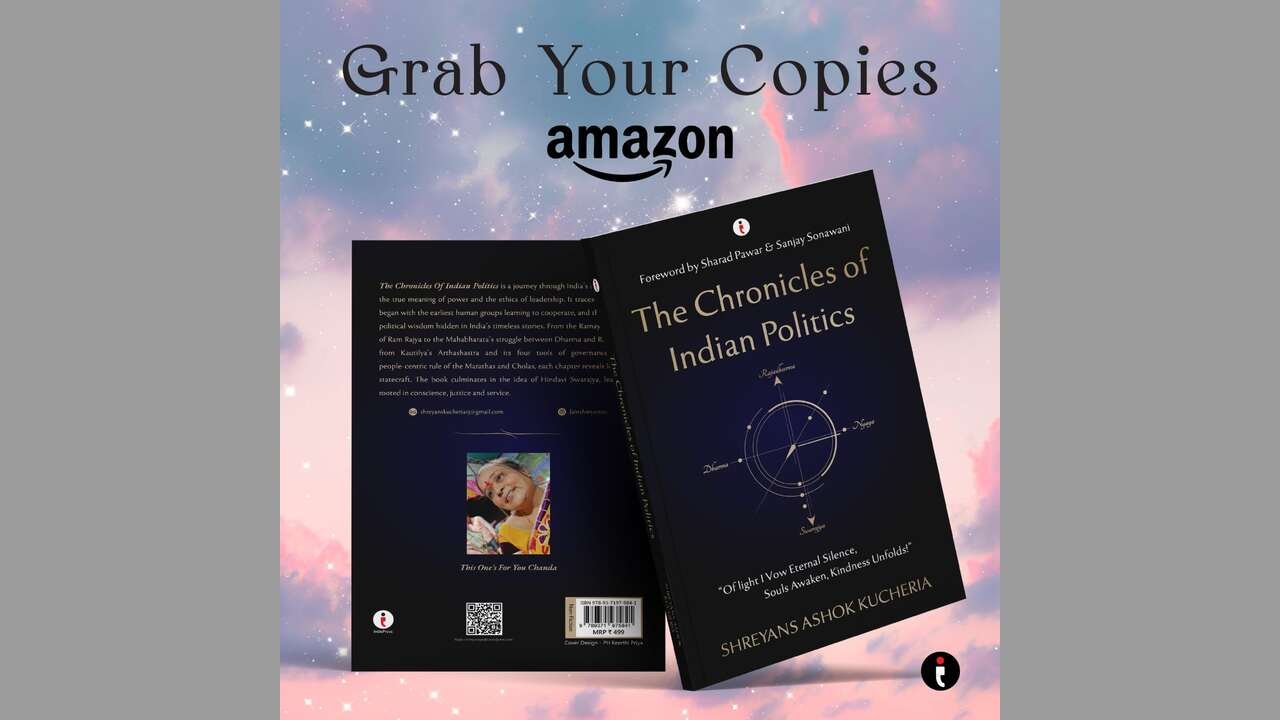
The Chronicles of Indian Politics is a thought-provoking exploration of politics not merely as a struggle for power, but as a civilizational force that has shaped India from its earliest tribal formations to sophisticated systems of governance.
In this book, author Shreyans Ashok Kucheria examines the deeper roots of political thought in India, drawing from the Ramayana, Mahabharata, and historical dynasties such as the Satavahanas, Cholas, and Rajput kingdoms. Rather than treating politics as a purely modern electoral activity, the book investigates enduring principles such as legitimacy, governance, diplomacy, ethics, and public welfare.
In a world increasingly marked by polarization, shallow discourse, and declining trust in institutions, The Chronicles of Indian Politics argues that politics must be understood as a discipline of responsibility. By revisiting India’s political heritage, the book offers readers a deeper framework for leadership, citizenship, and ethical governance in contemporary times.
1. Can you provide an overview of your book and how it addresses key challenges in the world today?
The Chronicles of Indian Politics explores politics not merely as a struggle for power, but as a civilizational force that has shaped India from its earliest tribal formations to structured monarchies and ethical statecraft.
Rather than treating politics as a modern electoral phenomenon, the book studies its roots in the Ramayana, Mahabharata, and historical dynasties such as the Satavahanas, Cholas, and Rajput kingdoms. It examines legitimacy, governance, ethics, diplomacy, and public welfare as enduring pillars of political order.
In today’s world—marked by polarization, shallow discourse, and institutional mistrust—the book argues that politics must be understood as a discipline of responsibility. By revisiting India’s political heritage, it attempts to offer a deeper framework for leadership, citizenship, and ethical governance in contemporary times.
2. What inspired you to write this book, and what expertise or experiences do you bring to the subject?
This book is deeply personal to me. It was my mother’s dream to see me write something meaningful—something that contributes to thought, not just conversation. Much of my persistence in completing this work comes from her quiet strength and unwavering faith in me.
At the same time, certain equations in life teach you about responsibility, silence, restraint, and emotional depth. They make you reflect more seriously on commitment, honour, and the weight of decisions. Some inspirations do not need public naming; they simply live in the discipline they leave behind. To describe them appropriately, they are souls awakened with kindness that quietly shape one’s journey.
Academically, my engagement with political thought has been driven by independent study across history, ethics, and civilizational philosophy. I approached this book not as a commentator, but as a student attempting to understand how power has shaped human society across centuries.
Ultimately, this book is the product of upbringing, reflection, emotional maturity, and a sustained attempt to study India’s political tradition.
3. What are the most valuable insights or takeaways readers can expect from your book?
Readers can expect three core takeaways:
Politics is not separate from ethics. Sustainable power requires moral legitimacy.
Leadership is institutional, not personal. Systems must outlast individuals.
Governance is a daily discipline. It is not merely a constitutional arrangement but an ongoing responsibility.
Through examples ranging from Krishna Niti to the administrative systems of the Chola dynasty, the book demonstrates how the balance between authority and accountability determines the durability of a state.
4. Can you highlight any case studies or real-world examples discussed in the book?
Two central case studies in the book are the political philosophy of Shri Krishna, which I term Krishna Niti, and the statecraft principles articulated in the Arthashastra.
In the Krishna Niti chapter, I examine Krishna not merely as a mythological figure but as a strategist and diplomat. His relocation from Mathura to Dwarka reflects strategic repositioning in the face of repeated aggression. His peace mission to Hastinapur illustrates the ethics of negotiation before war. His role in the Kurukshetra conflict demonstrates calibrated intervention—balancing moral purpose with tactical realism. It becomes a study in leadership psychology, alliance-building, and perception management.
The Arthashastra, attributed to Kautilya, provides a contrasting yet complementary framework. While Krishna represents contextual ethics in action, Kautilya represents codified statecraft—covering surveillance systems, economic management, foreign policy strategy, and the structured use of Saam, Daam, Dand, Bhed.
Together, these frameworks illustrate a timeless political tension: morality and realism are not opposites—they must coexist for sustainable power.
5. Were there any particular challenges you encountered while writing this book?
One of the primary challenges was writing about epics and historical rulers without romanticizing or oversimplifying them. I had to constantly separate reverence from analysis.
Another challenge was synthesizing vast historical timelines—from tribal societies to medieval polities—into a coherent political narrative without losing depth.
Overcoming these challenges required disciplined structuring and repeated revisions to ensure clarity while preserving intellectual seriousness.
6. What do you hope readers will gain from reading your book?
I hope readers gain political maturity.
Not cynicism.
Not blind idealism.
But maturity.
If a reader begins to view governance as a responsibility rather than a spectacle, and understands that leadership requires ethical discipline, then the book has served its purpose.
I also hope it encourages young people to engage with politics thoughtfully rather than emotionally. But more importantly, to engage at all.
7. How does the book remain relevant in a rapidly changing political environment?
Political actors change, but political structures and dilemmas remain constant.
Succession disputes, legitimacy crises, alliance building, moral compromise, and institutional reform are timeless dynamics.
Because the book studies patterns rather than personalities, its insights remain adaptable across eras. Political forms evolve, but the human psychology behind power remains remarkably consistent—and that continuity ensures the book’s long-term relevance.
Call to Action
Discover the deeper roots of leadership, ethics, and statecraft in India’s political history.
📖 The Chronicles of Indian Politics by Shreyans Ashok Kucheria offers a powerful perspective on how ancient wisdom can guide modern governance.
👉 Buy your copy on Amazon today and begin your journey into the civilizational story of Indian politics.


