


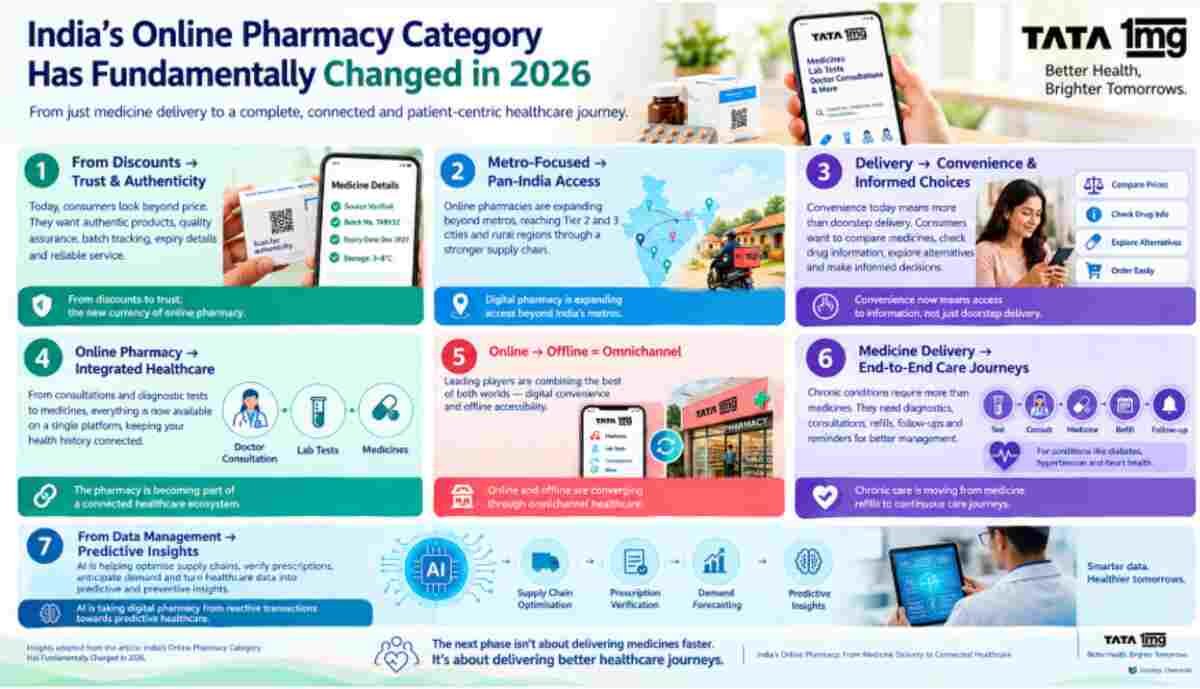
The pandemic accelerated the adoption of digital healthcare in India. The category of online pharmacy has changed since then. Customers’ expectations are evolving as they get more at ease with online healthcare platforms. Today, the growth of online pharmacy is driven by changing consumer expectations, digital infrastructure, and integrated healthcare services.
From discount-led acquisition to trust-led healthcare decisions
As online pharmacy adoption has matured, consumers increasingly evaluate platforms on factors beyond price, including medicine authenticity, quality assurance, and service reliability. That’s where online pharmacies have focused and gained a considerable advantage over traditional retail stores. They use verified sources of medications, track batch numbers, maintain temperature-controlled storage facilities, and include pharmacist verification. By recording details such as batch number, expiry date, and the amount received for each unit throughout their logistics chain, these platforms provide better transparency at every step.
Furthermore, studies suggest that product authenticity is one of the primary factors for repurchase in an online setting [1]. Though consumers still compare medicine costs across platforms, the authentication and validation of products have built trust among consumers, pushing them more and more towards verified medicine on online pharmacies. For example, Tata 1mg provides a QR code on all medicines purchased from the platform. On scanning the QR code, customers get details about the medicine’s source, batch information, storage conditions, and other product details. This provides greater traceability into the medicines, helping consumers to make more informed choices.
From metro-focused presence to pan-India coverage and Tier 2/3 expansion
Much of the Indian population is located in rural areas. However, retail stores are mostly concentrated in Tier 1 metro cities with limited presence in rural regions. The rural population often has to travel for kilometers to find a pharmacy store, not to mention that many of these stores have a narrow range of products available.
To address these challenges, online pharmacies have strengthened their services in these areas, especially Tier 2 and Tier 3 cities like Jamnagar, Satara, Srikakulum, Bilaspur, Amreli, etc., through a consolidated supply chain. This has enhanced the accessibility and availability of medicines. According to estimates, online pharmacies are now delivering services across 90% of pincodes [2]. Consumers in different regions have access to a wider range of medications provided by the online stores, significantly improving medicine availability across previously underserved regions.
From doorstep delivery to user convenience & informed decisions
Convenience and comfort have played a substantial role in the growth of online pharmacies. The doorstep delivery feature has been beneficial, particularly for elderly and disabled individuals. However, many still preferred offline purchases, probably due to habit or less trust in e-commerce. Over time, this behaviour has started shifting.
Today’s busy schedules have made consumers realize the value of comfort and time as resources. Convenience is no longer limited to doorstep delivery. Consumers increasingly value being able to compare medicines, check drug information, explore alternatives, and order them from one place, contributing to more informed choices.
From standalone online pharmacies to integrated healthcare platforms
Buying medicine is not an isolated exercise but a sequence of events including diagnostic tests, doctor consultation, and medicine purchase. Consumers generally have to switch from one platform to another to avail the relevant service, keeping the information scattered across different platforms. It can significantly impact healthcare, where every piece of data counts, especially previous lab test reports and prescriptions that provide an overview of the consumer’s medical history.
Many online pharmacies have identified and acted on this issue by developing a unified healthcare system. Tata 1mg has emerged as one of the leaders in this integrated ecosystem. It offers lab tests, consultations, and medications on the same platform, providing a complete picture for healthcare providers to support better health assessments.
From multichannel to omnichannel framework
For some individuals, face-to-face communication at the traditional retail store outweighs the comfort of online stores, especially for older individuals. Moreover, many individuals in India still don’t have smartphones or have trust issues with e-commerce. It has pivoted the online pharmacies towards an omnichannel strategy that can deliver services through both offline and online modes.
According to some studies, the ability to switch between two modes can improve consumer purchase satisfaction [1]. Pharmacies like Apollo Pharmacy, Tata 1mg and MedPlus already employ the hybrid framework, adopting an omnichannel strategy by building brick-and-mortar retail stores to synchronize with their digital operations.
From medicine delivery to end-to-end care journeys
The pharmaceutical marketplace can be essentially categorized into chronic disease and acute therapy segments. In recent years, the burden of chronic diseases like diabetes and hypertension has risen in India, becoming a key driver of the growth of online pharmacies [2]. Chronic therapies represent recurring healthcare needs, making continuity of care more important than one-time medicine delivery. However, chronic disease management is not restricted to buying medicines but includes regular testing, doctor guidance, and follow-ups.
Many key players in the online pharmacy space have recognized the potential in this area and introduced care journeys based on specific diseases instead of limiting themselves to medicine delivery. These end-to-end journeys offer diagnostics, consultations, pharmacy, follow-ups, refill notifications, and retest reminders to support disease management, which may also improve consumers’ adherence.
From data management to predictive insights
Technological advances, especially the revolution in artificial intelligence (AI), have further facilitated the use of online pharmacies. The previous use of technology in inventory monitoring and management by pharmacies has now extended to supply chain management, creating a non-modifiable ledger to enable drug traceability and cold-chain monitoring for temperature-sensitive medicines and ensure medicine integrity. This allows better transparency and supports patients’ safety.
Moreover, AI can help predict sales and create reminders that can help manage stock and scale up to meet consumer demand. Utilizing technology to verify uploaded prescriptions can also help prevent delays in dispensing medicines. AI can also be used to analyze huge amounts of data captured across digital platforms and generate predictive & preventive insights as well as recommendations.
Moving to the Next Phase
The online pharmacy category in India is no longer defined solely by medicine delivery. Increasingly, platforms are being evaluated on trust, accessibility, continuity of care, digital integration, and the ability to support patients throughout their healthcare journey. In response, many online platforms are expanding beyond traditional pharmacy services. Tata 1mg, for instance, has not only built its own warehouses for better quality control but also developed a unified healthcare framework to facilitate consumer comfort. As consumer expectations continue to evolve, companies that successfully combine technology with high-quality healthcare services are likely to shape the next phase of the industry’s growth.
The online pharmacy category in India is no longer defined solely by medicine delivery. Increasingly, online platforms are being evaluated on product quality, accessibility to a broader product range, digital integration, and the ability to support patients throughout their healthcare journey. This has prompted many platforms to expand beyond traditional pharmacy services. Tata 1mg, for instance, has not only built its own warehouses to achieve better quality control but also developed a unified healthcare framework providing multiple healthcare services on one platform to facilitate consumer comfort. As consumer expectations continue to evolve, companies that successfully combine technology with high-quality healthcare services are likely to shape the next phase of the industry’s growth.
References:
- Mishra S, Kulshrestha N, Naik K V, Pandya B S, Patel P, Shukla S. Omnichannel Retailing: Bridging the Gap Between Online and Offline Experience with Reference to Pharma Products. Int J Drug Deliv Technol. 2026;16(37s): 851-860. Available from: https://doi.org/10.25258/ijddt.16.37s.110
- Rizvi T, Vimal NR, Sahu S, Srivastava A, Kumar A. Rise of E-Pharmacies in India: A Case Study on Growth, Operational Models, Regulatory Framework, and Future Prospects. Int. J. of Pharm. Sci. 2026, Vol 4, Issue 5, 2102-2113. Available from: https://doi.org/10.5281/zenodo.20098700


