


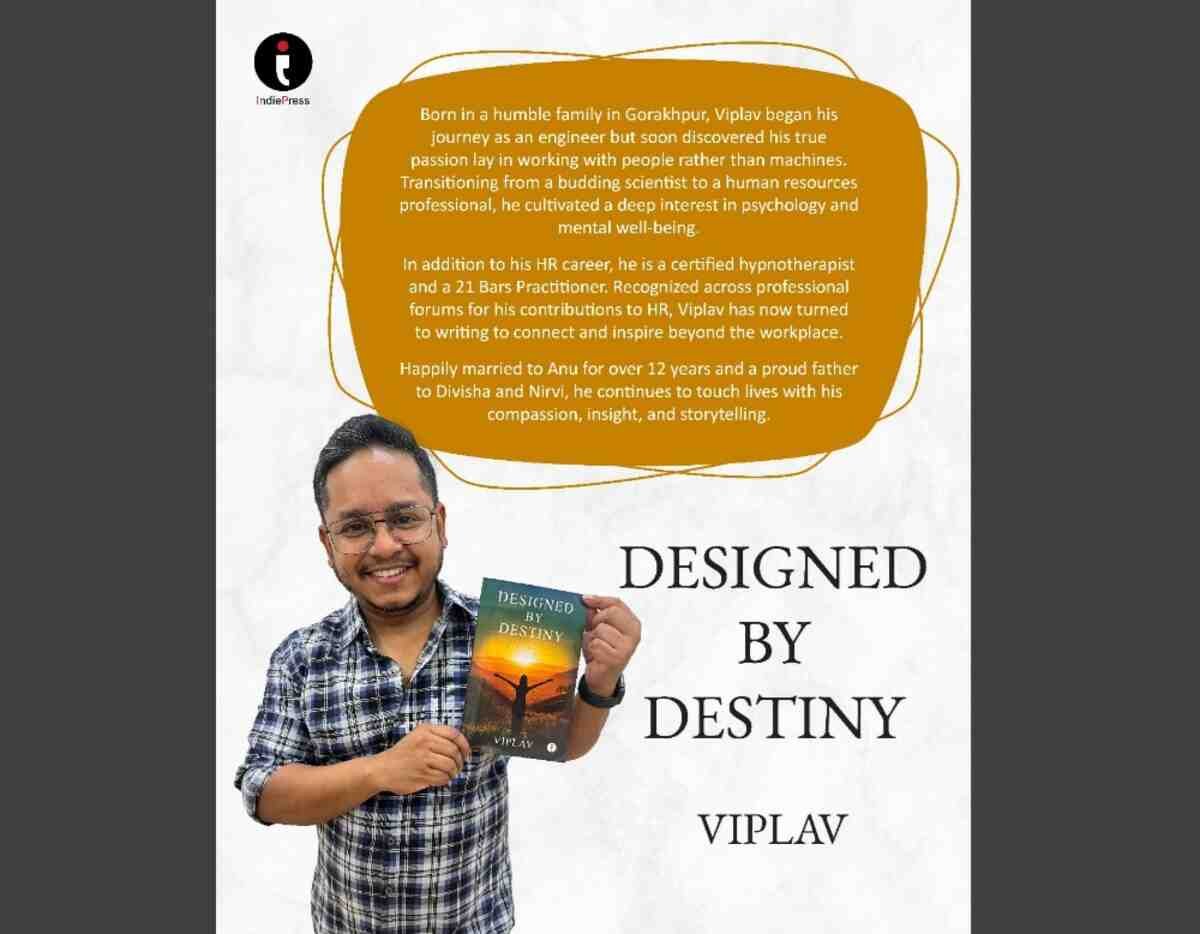
Life has pushed Shreya to her breaking point. With her world collapsing around her, she wanders to the banks of the River Ravi, searching for solace. Lost in memories of love and loss, exhaustion finally overcomes her, and she surrenders to what feels like her last breath.
But destiny has other plans. What seems like the end is only the beginning—one wrapped in mystery, resilience, and a life-altering secret waiting to unfold.
In Designed by Destiny, by Author Viplav Kumar Singh delivers a moving tale of pain, healing, and rediscovery. With vivid storytelling and raw emotion, this novel is a reminder that even in life’s darkest valleys, destiny often carves a path toward hope.
Best for readers who enjoy heartfelt, inspirational fiction with emotional depth and a touch of mystery.
- What sparked the inspiration for this book, and how did the story first take shape in your mind?
Books have always been my sanctuary—the place I turn to when life feels too heavy to carry. In some of my most challenging moments, it was the written word that gave me clarity, courage, and comfort. I’ve long been an avid reader and a passionate writer, but writing a book was never something I had formally planned. It was more like a quiet dream tucked away in the corners of my heart.
What truly ignited this journey was the encouragement of others. When people began reaching out to me on LinkedIn, saying that my short reflections and heartfelt posts had inspired them or given them hope during difficult times, something shifted within me. I realized that maybe, just maybe, my words could go beyond the screen—into something lasting.
This book is my tribute to the unseen beauty of life and a reminder to myself, and to others, that even in moments of burnout, there’s a seed of a new beginning. Sometimes, life buries its treasures in the darkest places. All we need is a little faith, a little pause— and the courage to dig deeper. That’s how this story was born: from lived experiences, raw emotions, and the belief that sharing our truth can light the way for someone else.
- Can you walk us through your writing process? Do you follow a set routine or have any personal rituals that help you get into the creative flow?
Most of my book was written during late nights, when everything around me was quiet and I had space to reflect. I didn’t follow a fixed routine—it wasn’t something I did every day. Instead, writing would happen naturally, often triggered by something during the day that made me think beyond my usual office work and daily tasks.
It could be a small incident, a thought, or a feeling that stayed with me. When that happened, I’d sit down and write. For me, writing wasn’t planned—it was more about expressing what I was really feeling in the moment.
- The characters in your book feel vivid and memorable—are they drawn from real-life people, or did they emerge entirely from your imagination?
Most of the characters in my book are inspired by real people I’ve come across at different points in life—some I’ve met personally, and others I’ve read or heard about. For example, the way I described the ashram and Guruji came from conversations with people who had actually spent time in ashrams across different parts of India. Their experiences gave me insight and helped me bring those scenes to life.
The settings and scenery in the book are a mix of my imagination and memories from my travels. I love exploring new places, especially through road trips to the hills, and many of those journeys have left a lasting impression on me. Shreya’s peaceful home, for instance, is drawn from little moments and places I’ve seen along the way—quiet towns, scenic hill views, and that special stillness you find in nature.
Travel has always been a big part of my life, and observing the world around me helps me create spaces and characters that feel real and relatable. Writing this way felt like stitching together moments from life and turning them into a story.
- Your book explores [specific theme or issue]. What led you to focus on this theme, and what message or reflection do you hope readers will take away?
Each one of us, at some point in life, faces the overwhelming chaos of circumstances— the moments when hope seems to slip through our fingers and we find ourselves hanging by the thinnest thread of faith. It’s in these very moments of darkness that our inner strength is forged. This journey, at its core, is for every soul who has ever felt abandoned by life, who has questioned their path, and who has wondered if destiny had forgotten them.
But life, in all its unpredictability, is always unfolding a plan—quietly, patiently. Sometimes what appears to be a setback is simply a setup for something greater. This story is a gentle reminder that no struggle is without purpose. Each challenge, heartbreak, or delay is shaping us, preparing us for what lies ahead.
Often, the burdens we carry are not as heavy as they feel—they’re magnified by fear, doubt, or expectation. When we pause, breathe, and step back, we may realize that the weight is more in the mind than in reality; This journey is about rediscovering that truth. It is an invitation to trust again, to believe that perhaps life hasn’t given up on us—it’s just teaching us to rise
- The setting in your novel feels detailed and immersive. How did you approach creating the world of your story, and were there real places or events that inspired it?
Absolutely! I’ve always had a deep love for traveling and long drives, and much of my world-building is rooted in those personal experiences. Whether it’s winding mountain roads, hidden coastal villages, or the energy of bustling towns, many of the landscapes and atmospheres in my novel are inspired by places I’ve actually visited. I tend to absorb the sights, sounds, and emotions of a place when I’m there—and later, they resurface organically in my writing.
Sometimes a particular road trip or a brief encounter in a remote town sparks an entire scene or setting. While the world in my novel is fictional, it’s very much coloured by real moments, textures, and feelings from the real world. I believe this lived-in quality helps make the setting feel authentic and emotionally resonant for readers.
- As an author, how do you strike a balance between originality and the conventions of your genre? Did you encounter any challenges while putting your unique perspective on familiar themes?
As a first-time author, my primary focus has been to express my original thoughts with honesty and emotional depth. Rather than being confined by the conventions of a specific genre, I approached the writing with the intent to connect with anyone who feels like life has reached a dead end.
While there are universal themes in the book—like hope, resilience, and self-discovery— I’ve tried to present them through a deeply personal lens. The biggest challenge was staying true to my voice while still ensuring that the narrative remains accessible and relatable. I believe that even familiar elements can feel fresh when they’re rooted in genuine experience and heartfelt intention.
- The pacing of your story keeps readers engaged throughout. How did you maintain tension and momentum across the narrative?
I’ve used a non-linear narrative to some extent in this story. The idea was to introduce each character separately and show their lives unfolding in different time frames or contexts. As the story progresses, these seemingly independent paths slowly begin to align. By the end, all the characters come together—connected not just by events, but by the shared themes and emotions in their life experiences.
- With changing media trends and evolving reader preferences, how do you see traditional storytelling adapting, and how do you shape your writing to connect with today’s audiences?
It’s true that media today has transformed how we consume stories—short-form content, reels, and instant access have shortened attention spans and shifted how people engage. But at the heart of all content, even the most modern formats, lies an age-old truth: everything begins with a story. Whether it’s a 30-second reel or a 300-page novel, the power of storytelling still holds people together.
I believe traditional storytelling will never truly fade. Yes, its form may evolve, but the essence—the emotions, the connection, the reflection—remains timeless. There’s something irreplaceable about holding a book, getting lost in the scent of its pages, and lying down with the words of a stranger who somehow understands your soul. That quiet magic may become less common, but it will never lose its value.
As a writer, I try to strike a balance. My language is simple and relatable, but the themes run deep—so that someone scrolling for relief, or someone curled up with a book can both find a piece of themselves in the story. To me, adapting isn’t about chasing trends, but about staying honest, while presenting emotions in a way that today’s reader can still feel, absorb, and carry with them.
When life feels broken, destiny writes a new story. Experience it in Designed by Destiny—available now on Amazon!


