


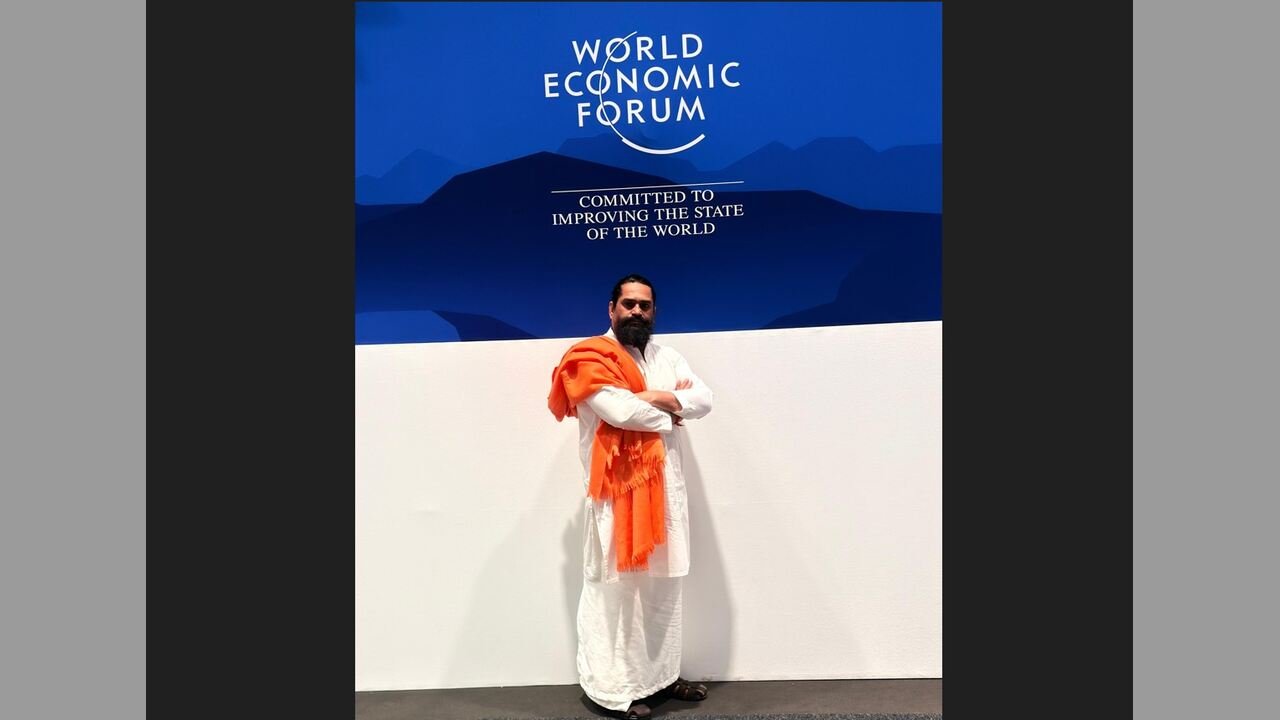
Amid the high-level discussions and strategic deliberations surrounding the World Economic Forum (WEF) in Davos, Indian thinker and global consciousness advocate Yogi Priyavrat Animesh emerged as a distinctive voice calling for a deeper transformation of global leadership — one rooted not in systems alone, but in human consciousness itself.
During January 20–21, in Switzerland, Yogi Priyavrat Animesh participated in a series of international dialogues held in the broader context of Davos, where global leaders, policy thinkers, and social influencers gathered to reflect on the future of humanity. While most discussions focused on economics, geopolitics, and technological transitions, his interventions introduced a fundamentally different dimension: the idea of a conscious and compassionate civilisation.
According to Yogi Priyavrat Animesh, the crises facing the world today — from geopolitical conflicts and climate instability to social fragmentation and mental health challenges — cannot be resolved purely through institutional reforms or technological innovation.
“The real crisis is not external. It is a crisis of human consciousness. Our systems are only reflections of the inner state of the human mind that designs and operates them,” he stated during one of the dialogues.
His central proposition at Davos was that global leadership today lacks inner maturity, and that without conscious awareness, even the most advanced policies risk becoming ineffective, divisive, or destructive. He emphasized that decision-making must evolve from ego-driven, fear-based patterns to awareness-driven, compassionate intelligence.
Conscious Leadership Beyond Power and Performance
In his meetings with international leaders, diplomats, social entrepreneurs, and corporate thinkers, Yogi Priyavrat Animesh consistently highlighted the concept of conscious leadership — leadership that is not defined by authority, control, or ambition, but by clarity, responsibility, and inner stability.
He explained that modern leadership structures are primarily trained for efficiency and performance, but rarely for self-awareness, emotional intelligence, or ethical depth. This, he argued, creates leaders who are technically competent but psychologically fragmented.
“A leader who is not conscious of their own inner fears, desires, and conditioning cannot lead a society toward peace. They may manage systems, but they cannot guide civilisation,” he remarked.
His dialogues focused on cultivating inner stillness, awareness, and compassion as core leadership capacities, rather than optional personal traits. According to him, conscious leadership is not a spiritual luxury but a global necessity in an interconnected world where decisions impact millions of lives.
Toward a Compassionate Civilisation
One of the most prominent themes in Yogi Priyavrat Animesh’s interventions at Davos was the idea of building a compassionate civilisation. He defined compassion not as emotional sympathy, but as a state of deep understanding arising from awareness of shared human existence.
He observed that current global civilisation is largely driven by competition, profit, identity politics, and power struggles — all of which reinforce separation and conflict. A compassionate civilisation, in contrast, would be rooted in:
- Psychological maturity
- Collective responsibility
- Ethical intelligence
- Inner stability of individuals
“Compassion is not an emotion; it is a level of consciousness. When consciousness matures, compassion becomes natural. Without this maturity, even humanitarian efforts remain superficial,” he stated.
In several closed-door meetings with leaders from Europe and international institutions, Yogi Priyavrat Animesh discussed how compassionate leadership can reshape governance models, corporate cultures, education systems, and conflict resolution mechanisms.
He proposed that future civilisations must integrate inner development with external progress, otherwise humanity risks becoming technologically advanced but psychologically unstable.
Consciousness as the Foundation of Global Peace
Unlike conventional peace dialogues that focus on treaties, diplomacy, and political negotiations, Yogi Priyavrat Animesh framed peace as a consequence of collective consciousness, not merely a strategic outcome.
He argued that wars, social unrest, and ecological destruction are not accidental events, but expressions of fragmented human awareness operating at scale.
“Peace is not something to be negotiated; it is something to be realised. When human consciousness matures, conflict becomes unnecessary,” he said.
His presence at Davos introduced a philosophical and psychological layer into global discussions, suggesting that true international stability cannot emerge without inner transformation at the level of individuals, especially leaders.
A Different Voice at Davos
In a forum often dominated by economic indicators, policy frameworks, and geopolitical narratives, Yogi Priyavrat Animesh’s contributions stood out for their non-ideological, non-political, and deeply human approach.
Rather than proposing new systems, he emphasized transforming the inner operating system of the human mind itself.
Observers noted that his dialogues attracted interest precisely because they addressed a growing global realization: that humanity’s challenges are no longer just technical or structural, but existential and psychological.
By placing consciousness and compassion at the center of global leadership discourse, Yogi Priyavrat Animesh positioned himself as a unique international voice advocating a new paradigm — one where the future of civilisation is determined not by power, but by awareness.
His message at Davos was clear and uncompromising:
“The next stage of human evolution is not economic or technological. It is the evolution of consciousness. Without that, no civilisation — however advanced — can survive sustainably.”
For more details:


