


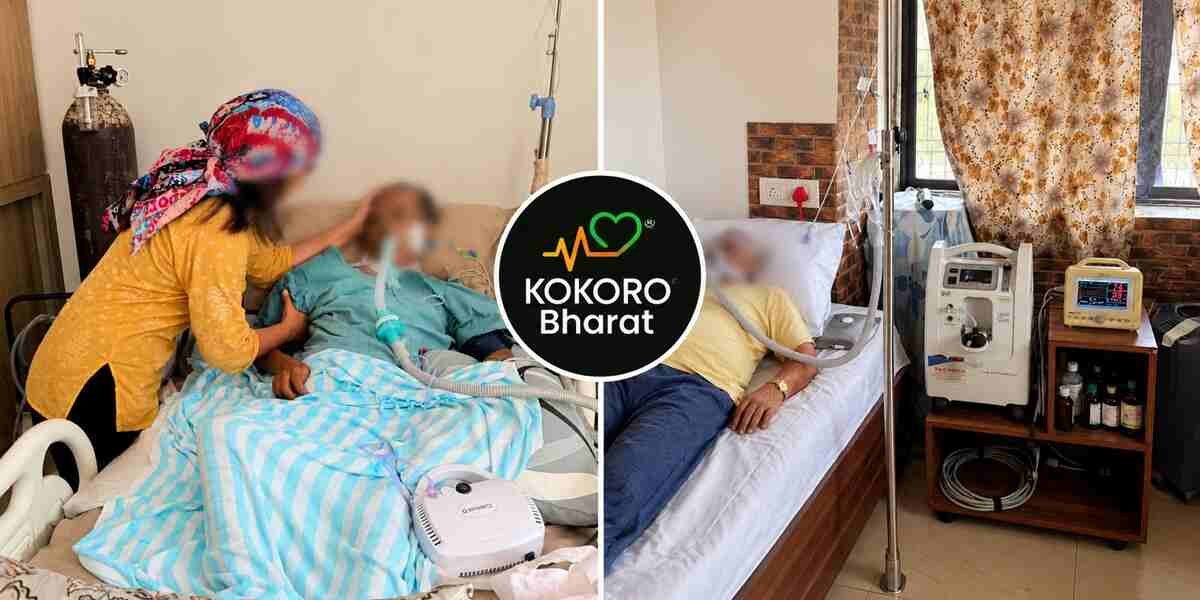
By one estimate, India has about one ICU bed for every 14,500 people. A year-old startup thinks some of the patients in those beds would be better off recovering at home, and that the numbers prove it.
Every ICU bed in India carries an unspoken question: does the patient in it still need to be there? For a sizeable share of long-stay patients, the honest answer is no. A patient weaning off a ventilator after pneumonia, a stroke survivor with a tracheostomy, an elderly patient on long-term oxygen. They are stable. What they need is monitoring, skilled nursing and the right machines, not the operating theatres, emergency teams and imaging suites they are paying for by the day.
KOKORO Bharat, founded in August 2025, is built on that gap. The company sets up ICU-level care in patients’ homes across Delhi NCR, Mumbai, Bangalore, Lucknow, Pune, Indore and Hyderabad, among other cities, and says it has served more than 1,000 families.
A system built on too few beds
The numbers behind India’s critical care are stark. A 2020 estimate by the Center for Disease Dynamics, Economics & Policy put the country’s ICU capacity at roughly 95,000 beds for more than 1.3 billion people, about one bed for every 14,500 Indians. Germany, by comparison, has at least four times as many ICU beds per person. Around 62% of India’s ICU beds sit in private hospitals.
The people who staff those beds are scarce too. India has 2.6 nursing personnel per 1,000 people, the Union Health Ministry told the Rajya Sabha in July 2026, below the WHO benchmark of three.
Families pay for much of this themselves. Out-of-pocket spending made up 49.9% of India’s current health expenditure in 2022-23, according to the latest National Health Accounts. In plain terms, nearly half of every rupee spent on health in India comes straight from a household’s pocket.
The founder saw this first-hand. When the mother-in-law of founder and CEO Rammohan Sundaram was admitted to the ICU with severe pneumonia, the family faced a question many households know: what happens once she is stable? “Discharge is treated as the end of the problem, but for the family it is the start of a new one,” says Mr. Sundaram. “Families end up hiring nurses, renting equipment and coordinating with doctors on their own. All the pieces of care exist, but no one brings them together.”
The economics of a hospital bed
Insurer Manipal Cigna puts ICU charges at ₹7,000 to ₹30,000 a day, and ₹15,000 to ₹60,000 or more with a ventilator. Add medicines, consumables, tests and specialist visits, and a day in the ICU of a large private hospital in a metro can easily cost ₹50,000 to over ₹1 lakh.
Much of that daily rate pays for things a stable patient no longer uses: emergency teams, operating theatres, imaging and the overheads of a large building. The home model strips those out. What remains is the core of what the patient needs: a hospital bed, a monitor, oxygen or a ventilator, a trained nurse and a doctor on call.
KOKORO Bharat says its home ICU setup costs around ₹5,000 a day, which it says reflects the actual cost of the care a stable patient needs at that stage. That puts a month of ICU care at home at roughly ₹1.5 lakh, often less than what a few days in a private hospital ICU can cost.
There are costs the hospital bill never shows. Relatives sleep in corridors, take leave from work, and travel in from smaller towns. In a home setup, the family is already where the patient is.
The system gains too. Every stable patient who moves home frees an ICU bed for someone who is not stable.
One team instead of five vendors
Home care is not new in India. What KOKORO Bharat argues is broken is coordination. A family bringing a critical patient home typically deals with an equipment vendor, a nursing agency, an attendant service, a diagnostics lab and the treating doctor, separately.
The company combines these into one service. A home ICU setup can include a hospital bed, multi-parameter monitor, oxygen concentrator or ventilator, suction and infusion equipment. Trained nurses and attendants work in shifts around the clock. Physiotherapy and home diagnostics cover recovery and routine tests.
“Hospitals are where acute treatment happens. We are the continuation of that care,” says Vinod Khedekar, co-founder and COO. “Our job is to make the move home safe, fully equipped and supervised, so the family is not running a hospital on their own.”
Where the model has limits
Home ICU care is not for everyone, and the company does not claim it is. It is not for emergencies, for patients who are still unstable, or for anyone whose treating doctor advises against discharge.
“We would rather say no to a patient than take a risk with one,” says Mr. Khedekar. “Trust in this category will be built one family at a time.”
Winter, and the decade ahead
The timing is pointed. With Diwali on 8 November, north India is heading into its worst air of the year, and respiratory illness rises with it. In an AIIMS and ICMR study of four Delhi hospitals in 2018-19, winter PM2.5 averaged 190 µg/m³, nearly 13 times the WHO’s 24-hour guideline. Of the patients the study enrolled with acute respiratory symptoms, 41% came in during winter, more than in any other season.
For patients with weak lungs, every polluted season brings more admissions, longer stays and more pressure on the same limited beds. It also strengthens the case for recovery at home, where indoor air can be controlled and the patient monitored without repeated trips to hospital.
The longer trend is demographic. India’s population aged 60 and above is set to reach 15% by 2036 and 20.8% by 2050, according to UNFPA’s India Ageing Report 2023. Chronic illness and long-term care needs will grow with it, and hospital capacity cannot keep pace on its own.
“Healthcare in India is still built around the hospital, but recovery happens at home,” says Nupur Sharma, co-founder and Chief Marketing Officer. “If the home becomes a trusted extension of the hospital, families stop carrying the system on their own shoulders.”
Whether home ICU care becomes mainstream will depend on clinical standards and trust. The case for it is already written in India’s bed counts and hospital bills.


